

“Children aren’t part of our life plan. Not for us.”
People who say this, or some permutation of it, are, in one way, correct. Children are not part of the plan. As C.R. Wiley notes in Man of the House, children are the plan. On the surface, they are a couple’s retirement plan, but beyond that, they are also the plan for life and civilization itself. Children are what make it possible, and desirable, in the first place.
Either you will depend on your own children in your old age, or you will depend on the children of others. No other options. There is no such thing as “not being a burden” when you grow old. You will be a burden to someone.
Some couples cannot have children, which is a tragedy, but to make it a deliberate choice is shortsighted and selfish. From a purely pragmatic standpoint, you are deliberately enslaving yourself to the vagaries of people who don't really care about you. Every relationship you’ll have, after a certain point, will be mercenary in nature.
All of those nurses who will take care of you? Someone else’s children.
The people who prepare your meals and clean your room? Someone else’s children.
The entertainment you watch as you slowly drift away? Created by someone else’s children.
The funding of your pension and social benefits? Provided by someone else’s children.
The entire infrastructure that supports your existence? Maintained by someone else’s children.
But even before you retire, while you still have life in your bones and time has not yet ravaged your strength or faculties, you still depend on other people’s children. The business you own? It requires workers and customers, the ranks of which will be filled by other people’s children. That cubicle email job with the nice salary? Made possible only through the demand generated by other people’s children. You can’t escape this fundamental reality.
If the population suddenly shrank, what do you think that would do to consumer demand? The economy in general? Without children, the economy stagnates or shrinks. It might cause hyperinflation as the money supply is distributed among fewer people. Your continued prosperity depends on other people’s children. The DINKs’ (dual income no kids) ability to waste their lives on endless traveling and Saturday brunches, their ability to blithely ignore the future, and their illusion of independence, all depend on the labor of other people’s children.
This relationship used to be more obvious when more people had farms, and they literally depended on their children for extra labor. They knew children were an investment. Eventually, they expected a return.
However, I’m not making a primarily economic argument, though that can’t be ignored and is the most obvious. I’m going to make an even bolder claim.
The only reason DINKs don’t feel existential dread or ennui every day of their lives is because of other people’s children. They can only ignore the creeping shadows because they assume most other people won’t be as selfish.
If people stopped having children, even art itself would cease to be valued.
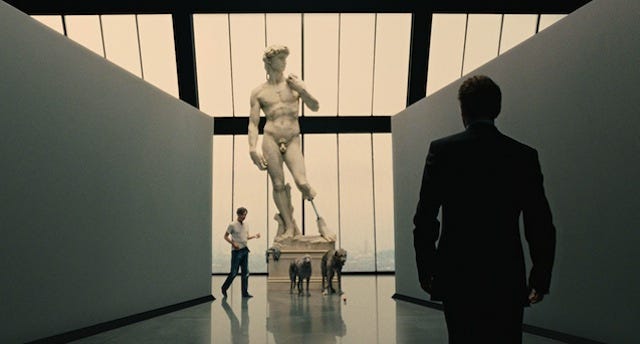
There’s a scene in the film Children of Men where a cousin of the protagonist restores art damaged in the chaos caused by mass-scale human infertility. No new child has been born in 18 years. In the movie, he is working to restore Michelangelo’s David. The protagonist asks him what the point of it is. In 100 years, no one will be around to see it. Mankind has a known expiration date.
Even the lonely, childless autuer toiling away at his artistic vision toils in the hope that other people will look upon his work. Ideally, long after he is dead. No artist truly works only for himself. He intends for people to experience it. Otherwise, the novelist would keep his manuscript on his computer, and the painter would keep all of his canvases stored safely in his basement.
Very few artists achieve lasting fame. Very few works are added to the canon that will be studied in the decades and centuries after he is gone. But he hopes, and that hope is part of what drives him. Without children, there is no hope. If not his own children, then the children of other people. Someone must be having children for art to have any lasting significance. Hope drives the actions of most people, and without children, hope eventually withers on the vine.
In the movie, the cousin’s answer to the protagonist’s question as to why he wastes his time doing something no one will be around to see: “I just don’t think about it.”
That is the same mantra of married couples deciding not to have children. “I don’t want to think about it, so I won’t think about it.” Willful blindness is the only option. They either cannot or will not look beyond their own noses.
Of course, not everyone can have children. Not everyone should have children. There have always been classes of people who have abstained, such as priests, missionaries, sages, hermits, and other disciplines or orders.
The difference, and the unspoken expectation, was that these people would dedicate themselves to some other higher calling, to serve their fellow man, to serve the children of others, in some other noble way that might not be possible if they had children of their own. The expectations for them were greater, not lesser. Their goal was not to live a life of endless leisure and dissipation, unencumbered by responsibility, sleeping in, binging entertainment, drifting through life with a purpose consisting only of maximum pleasure, languishing in immaturity.
What’s more, these childless people would not expect the world to revolve around them. To complain about how a society caters to families with children would be an obscenity, a branch complaining about how the roots of the tree get to taste the water of the soil first.
When someone says, “We just don’t want children,” what they’re really saying is that they want all of the luxuries of modern civilization without any of the responsibility that comes with it. Because they will depend on everyone else’s children.
And without children, civilization ceases to be. Most of what is good and beautiful would eventually fade. “Be fruitful and multiply” wasn’t only a command, but a foundational pillar of reality, one we ignore at our peril.
Brilliant framing of a critical and widely misunderstood concept. Overpopulation is not the concern, unless you view humans as glorified animals who are net negatives. Underpopulation is a far bigger concern!
Love this, thank you. Yet again, God’s created order cannot be ignored. This is the strong men = good times, good times = weak men, weak men = hard times, argument. Luxury and excess create the weakness and godlessness, self dependence and eventual failure.